Exploring the Identity of Seventh-day Adventists: Insights from the Oxford Handbook Event
Written by: IMC Director Simonique Dietz
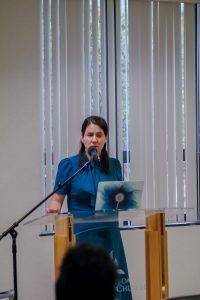
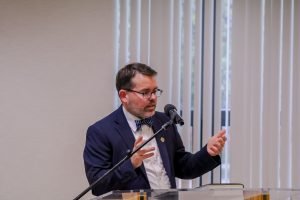
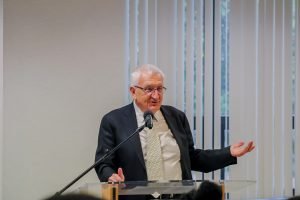
TAKOMA PARK, Md. — Who are Seventh-day Adventists? Are they fundamentalists? What role do they play in today’s society, and how does the church interact with movements like feminism? These questions were at the center of a recent event hosted by the Honors College at Washington Adventist University (WAU), where authors and editors of the Oxford Handbook of Seventh-day Adventism gathered to discuss the handbook’s insights. The event, held at the Sligo Seventh-day Adventist Church, featured contributions from scholars and editors including Michael Campbell, Nicholas Miller, Denis Kaiser, Heidi Campbell, and Nikolaus Satelmajer.
Nicholas Miller, a professor at WAU and one of the handbook’s editors, discussed the philosophical roots of Adventism, particularly a concept known as “common-sense philosophy.” This approach emphasizes finding divine messages in both Scripture and nature, developing a thoughtful, principled moral understanding, seeking for harmony between faith and reason. Miller noted that Adventism initially embraced this openness, but since the death of Ellen White, moved toward a more fundamentalist approach to Scripture, which it has since reconsidered.
Heidi Campbell focused on the roles of women in the Adventist Church, highlighting how figures like Ellen White were essential to the church’s early development. Contrary to views that White was an exception among Adventist leaders, Campbell’s research underscores a history of significant contributions by women in roles such as missionaries, administrators, and church leaders. Acknowledging these contributions, she argued, is essential as the church continues to explore leadership opportunities for women today.
Nikolaus Satelmajer, a book reviewer, provided reflections on Adventism’s unique identity. He explained that while the Adventist Church is conservative, it differs from fundamentalism in significant ways, especially in its approach to Ellen White’s writings. White’s work is seen as a guide, not an authoritative filter for scripture. Satelmajer noted that in today’s polarized world, Adventism’s commitment to unity in faith over politics is particularly relevant.
The Oxford Handbook of Seventh-day Adventism, published by Oxford University Press, has been widely praised as a balanced, scholarly resource on Adventist history and beliefs. The Adventist Review commended its scope, highlighting the inclusion of perspectives from both Adventist and non-Adventist scholars. Available in academic libraries worldwide, the handbook serves as an accessible introduction to the church for scholars, students, and general readers.
Michael Campbell, WAU religion professor and lead editor, described the handbook as the first comprehensive reference on Adventism published by a major academic press. Campbell emphasized that beyond the prestige of publishing with Oxford, the handbook’s value lies in fostering a deeper understanding of Adventist identity among readers from various backgrounds.
For those interested, discounted copies are available through WAU’s Honors College. A recording of the October 26 event is also accessible here, for those wishing to hear more about the book and the perspectives shared by its contributors. If you want to keep up to date with the Center for Law & Public Policy’s newsletter The Branson Capital Report, please email co-directors, Dr. Jonathan Scriven at jscriven@wau.edu or Dr. Nicholas Miller at nmiller@wau.edu.